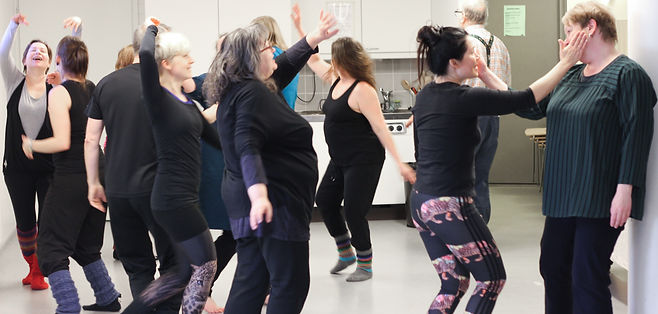
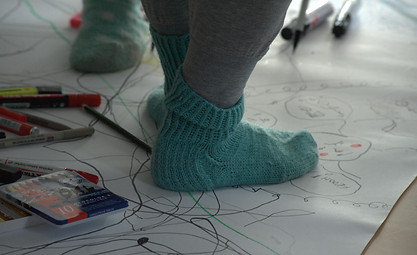
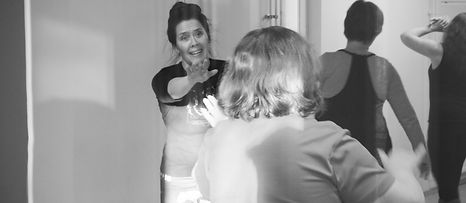
Dialogical audience development model is a holistic, democratic and artistic tool for audience development work in which the viewer experience becomes seen, heard and shared in the form of performing art.
The commentary performance of the audience can be implemented both in a short and long time scale.
Warm-up of the audience group using the methods of consciousness work such as breathing and doing different meditative exercises before experiencing the original artwork is the corner stone of the Dialogical audience development model. This corner stone lead us to the presence of witnessed viewership or experiencing. We did not evaluate the artworks but accepted, were exposed to, breathed and were in the presence of the artworks. We let the artwork have an influence on us totally and in a multidimensional way.
FINDINGS
Findings of the group
“I understood that there is a different kind, a deeper way to look at and deal with art. I see that the Dialogical audience development model has an anti-categorising effect that the definition of the “target audience” diminishes and even goes away…”
-Taru-Piritta Kallio, Community theatre group Aikuiset naiset ja Petri-
“The art field is lacking this kind of a dialogue. The model offers dialogue without art jargon. If an artwork is a rock that is thrown in to the water, the commentary performances of the audience are parts of the circles that are formed on the surface of the water.”
-Heli Kärkkäinen, Community theatre group Aikuiset naiset ja Petri-
“Jointly experienced, shared and processed performance makes any kind of art experience many times richer. Art belongs to everyone and everyone has the permission to make art.”
-Soile Härkönen, Community theatre group Aikuiset naiset ja Petri-
“This project has strengthened my understanding that each one experiences artwork in their own way. The makers may want or not want to say/convey certain things but they cannot determine the experiencer´s or viewer´s experiences or interpretations on the artwork.”
-Tiina Pietiläinen, Community theatre group Aikuiset naiset ja Petri-
“The art field will get a tool from this enabling it to get feedback from its work and increase the audience figures.”
-Jaana Hummasti, Community theatre group Aikuiset naiset ja Petri-
One of the biggest findings from the audience discussions of the project was that an idea still remains within the audience that I have succeeded as a viewer when I understand what the artist has wanted to say with his artwork. Something should be made quickly to change this idea, for instance through the audience development work. For example to truly take in national use the Dialogical audience development model through which at least the participants of the pilot audience project are beginning to understand the whole extent, individuality and possibilities of the viewership. If I spend two hours at the presence of performing art trying to solve and find out the starting point of the artist and what he has wanted to say with his artwork, upon what is my own viewer experience based then? Performing? Art experience is not a school work that once you have solved it the artist will draw you a flower and grade 10+ on your ticket. Artwork is always a chance for something new, something fresh and a chance to face the structures and viewpoints of the viewer. A chance for change.
Working with the viewer experience of performing arts is a real treasure chest where the effectivity of art becomes visible in all the layers. Viewer experience is also something else than an opinion. In our own work we have used dreams, bodily experiences, memories, feelings arising from the performance space, personal processes woken by the original artwork, associations. We have explored our own individual art perception. We have explored our viewership, what kind of viewer profile we have had and are having at the moment. We have explored how our own conditionings affect the performance experience. How the daily events have an influence on how I am able to be present and alert at the art experience. In which different ways the various artworks affect us. How easily we judge unpleasant, especially confusing artwork as bad. How difficult it is for us as viewers to be present for art if we feel that we do not understand anything about the artwork. Can art be understood? And why should it be understood? I myself wish in the future to face more of art audience that has the ability and willingness to surrender and be exposed to, not knowing all where it may lead to. Art audience that has the courage to be with their confusion. Art audience that knows that one is genuinely interested in their individual viewer experience even though it was something totally different what the makers of the artwork have thought or wanted to say with their piece.